


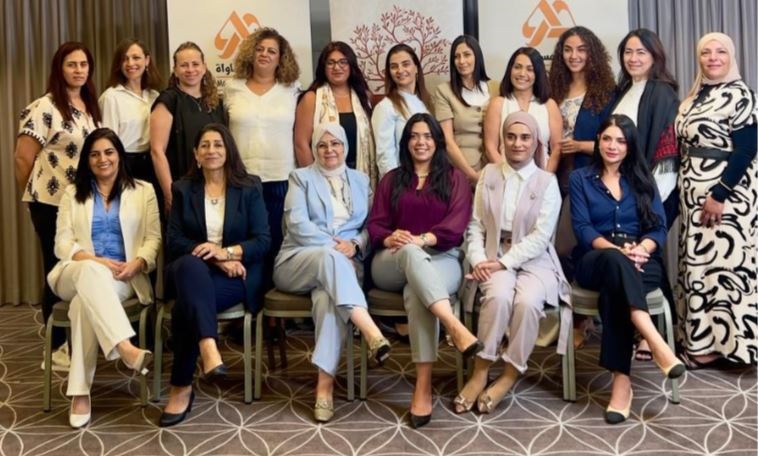
“We acquired diverse tools that connect directly to reality and the field—from media discourse to local policymaking—that will soon form a practical foundation for new initiatives,” summarized several participants at the intensive two-day gathering of the Arab Women Leaders’ Network, held on September 12–13, 2025.
The project, led by the Mossawa Center in partnership with the Friedrich Ebert Foundation, supported by the European Union, and in collaboration with We Power, Itach-Ma’aki, and Women in Politics, seeks to establish a strong Arab women’s network that redefines women’s presence in local and national decision-making arenas.
What distinguished this gathering—which combined the network’s fifth, sixth, and seventh meetings, held at the Legacy Hotel in Nazareth—was its departure from conventional networking and theoretical discussion. Instead, it evolved into an extended workshop that blended hands-on training, knowledge production, and field experience in the heart of Nazareth.
⸻
Day One: From Storytelling to Influence
The first day opened with an interactive session led by Suhad Salman Mousa, Executive Director of Mossawa, and Dr. Rawda Marcus-Makhoul, reflecting on progress to date before launching a series of trainings focused on developing tools of speech and influence.
• Journalist Shireen Younes conducted a workshop on media empowerment and feminist narratives.
• Journalist Bakr Zoubi explored challenges and opportunities in engaging with Hebrew-language media, sparking a broader political discussion.
• Tamim Zoubi and Lilian Abed guided participants in crafting personal narratives through imagery and visual marketing.
• In the evening, Wisam Shouli posed a forward-looking question: how can women leaders leverage social networks and artificial intelligence to expand their visibility?
The day concluded with a walking tour of Nazareth’s Old City and a visit to the Al-Sabat Association Museum, highlighting cultural memory as an integral part of contemporary struggles.
⸻
Day Two: From Individual Initiatives to Structural Change
The second day was dedicated to collective work:
• Juhaina Sayfi facilitated the drafting of local women-led initiatives.
• Nibal Ardat, Mossawa’s Legal Advocacy Coordinator, led a practical exercise in developing a policy paper outlining a vision for change and concrete steps to influence decision-making.
The final session brought participants together to consolidate outcomes and plan upcoming meetings.
⸻
“No Women’s Work Emerges from a Void”
“This project builds on the accumulated struggles of Palestinian women who fought for their rights—as women and as Palestinians—demanding both civil and collective rights. It continues to refine tools for amplifying women’s presence in decision-making spaces,” said Dr. Rawda Marcus-Makhoul. She emphasized: “No feminist action emerges from a vacuum. It arises from dynamic circumstances shaped by the labor and activism of women and men across multiple spheres, not only the feminist one. Mossawa’s advocacy for the rights of Palestinian Arab citizens, within a discriminatory system, is an extension of this broader effort.”
The significance of this intensive workshop lay not only in its diverse sessions, but also in embodying the project’s philosophy: moving from women as individuals to women as a network, and from marginal presence to a political and social project determined to create tangible impact.
