


BAKER ZOUBI
Since the Nakba and until today, the Israeli government has never ceased to deal with Palestinians
in the Negev as a “historical mistake” that needs to be corrected. The land was confiscated, and the
struggle continued from the Negev lands; the villages remained without recognition, and the families
were cornered with poverty and deprivation. And by seizing the land, their source of income was
confiscated as well. And the landowners and farmers became unemployed, Bulldozers were ever
absent from the scene, especially in recent years. But what is most dangerous about this policy, is
that it was never presented as an exception or a temporary solution, instead, it is a long term plan
with one goal: to separate the palestinian community in negev and rebuild it in accordance with the
standards of the political parties that control the government, by pushing this Palestinian community
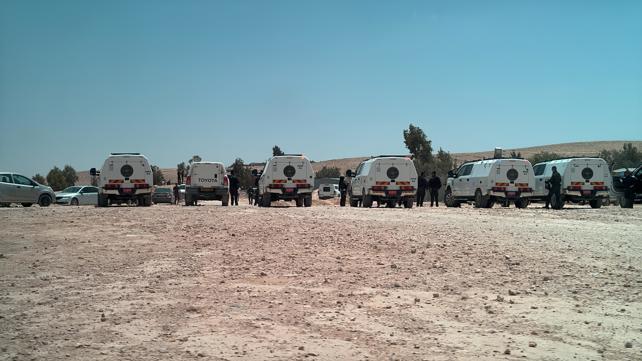
into the ghetto or even displacing them. In the past week, tens of houses were destroyed in Alsir
village, making this village a new title in a long series of old and renewed suffering. This was not the
first time, and it will not be the last, apparently. And what happened to Alsir village is awfully similar
to what happened with Alaraqib village, or Umm Al Hiran, that has been destroyed and its people
were displaced to Al Hora village after the murder of the teacher “Yaakob Abo Alqiaan”.
The latest government decision approved by the Israeli government on Sunday, 21.09.2025, reveals
the depth of the racial supremacy that is controlling the current government. Minister of Diaspora
Affairs and the Fight Against Antisemitism, Amichai Chikli, presented a broad plan that was
approved almost unanimously, and under which four inter-institutional ministerial teams were formed.
Their goals are clear and dangerous: to stop what is called “Palestinization” in the Negev,
strengthening Israeli Identity, encouraging military and national service, and local government
reorganization. These teams are required to submit recommendations within 90 days, which will then
be submitted to a special committee headed by the Director General of the Ministry of Diaspora
Affairs, to be transformed into a binding government decision within five months.
This project asks basic questions: what country publicly announces that the sense of belonging that
some of its civilians feel towards their nation, their people, and their identity is a danger that must be
erased? And how can a plan, such as this one, be called a “development” project when in reality, it is
a horrific political and cultural uprooting complemented by a project of demolition, unemployment,
and land confiscation?
The decision includes the creation of a governmental staff to address marriages between men from
the Negev and women from the West Bank or Gaza. The government views familial and human
connections as a "threat" because it empowers the connection between a Palestinian in Negev with
their Palestinian siblings beyond the green line, which separates the Palestinians and allows Jewish
people to settle freely. The state interferes in the smallest details of personal life, in an attempt to
sever the ties of blood and kinship, as if the goal is to isolate the Negev from its nation completely.
This clause alone reveals that this is not an issue of “local administration” or “societal issues”, but
rather a political colonial project that aims at dismantling society and stripping it of its identity. The
proposal joins the "temporary" citizenship law amendment, which has been extended since 2003,
and denies citizenship to anyone who marries a resident of the West Bank or Gaza Strip.
At the same time, this decision works on “empowering Israeli Identity”. By producing educational
programs that erase Palestinian identity and reshape the consciousness of generations, and
transform belonging to the state as an alternative to belonging to the people, the land, and the
history. This is not education; this is the engineering of a collective identity. The school is used as a
silent bulldozer that breaks down language, culture, and collective memory. And what is feared is
that it is realized by mandating Hebrew as a central language in schools, and marginalizing Arabic,
as another step of separating Palestinians from their historical roots. Within this framework, the
introduction of female soldiers as teachers in Negev schools stands out as a very dangerous matter.
Firstly, because it targets the identity of Palestinian students through educating them with the final
goal of conscripting them into the military and growing the gap between them and their Palestinian
identity. And secondly, because it presents a threat to arab women's work opportunities who are
college and university graduates in education, particularly during this time when thousands of arab
teachers are suffering from unemployment. The inclusion of female soldiers strikes the last bastion
of employment opportunities for women in education, while also delegitimizing Palestinian university
degrees, further excluding arab cadres and having serious repercussions for the identity of
education and employment opportunities.
In this context, we note the success of the "Druze Identity Building" project implemented by
government ministries, led by the Ministry of Education, to separate the Druze Arabs from their
people and exploit them to practice occupation over their people, without them obtaining the most
basic civil rights, including the right to housing, planning, and land. They have been marginalized
along with the rest of their people through the Nation State Law, and they are being persecuted
through the Kaminitz Amendment to the Planning and Building Law.
The third step of the plan is about encouraging military and civil service. Meaning that Palestinian
youth, who saw their homes destroyed daily, and are watching from a short distance their families in
the Gaza Strip going through a comprehensive genocide, in turn, they are asked to hold a gun in the
service of the same institution that destroys their homes and uproots their villages and besieges their
people. This cruel paradox is not in vain, but rather a part of policy: transforming the victim into a tool
in the hands of the executioner. And reproducing the youth of the Negev as a subordinate force
instead of being a part of their community and a part of the true peace camp between their people.
The fourth clause deals with “local administration”. The government wants to redraw the
organizational map of the local councils that serve Beduin villages, and those that are unrecognized.
Instead, they are expanding these councils, giving them resources, and investing in them like their
Jewish counterparts. The plan is moving towards further restriction and control. The result is that
local authorities in the Negev will remain weak and poor. Surrounded, with no resources, and unable
to provide services, the Palestinian in the Negev remains surrounded by fiscal deprivation and
political marginalization.
These clauses are not detached from the civil reality. Rather, it is a direct extension of the demolition
policy that has increased in the past two years, and an embodiment of the constant incitement that
portrays Palestinians in the Negev as a demographic danger and an organized crime. What the
government is doing is codifying this policy and turning it into an official decision, where demolition,
distortion of identity, and stripping society of its familial, national, and cultural roots became a
recognized policy, not just a practice. The demolition of Al-Sir village last week was a live example
of the connection between law and reality: a ministerial plan on one hand and an unstoppable
bulldozer on the other.
Through Mossawa Center’s involvement in racial issues within the 48 borders, it was made clear that
the fate of the Negev aboriginals from these policies has always been bad. If it's compared to the
rest of the arab population, we find that the Negev is the most targeted: where most of the demolition
orders are executed, where deprivation policies are practiced more rigorously. And when the state
racism is most clearly manifested. The most recent decision is not outside this context, but rather a
continuation and an escalation.
The streets were not silent. The protests that occurred in Be’er Sheva during the last week and the
last few months against the demolition policy and discrimination were important. It was a powerful
cry against bulldozers and identity-scraping tools. The recently organized "Pride and Dignity"
demonstration stood out as a clear message that Palestinians in the Negev are clinging to their
rights and identity despite all the policies. But these movements, regardless of how important they
are, reveal the need to accelerate the struggle. If the government escalates to the level of ministerial
committees and government decisions, the popular response must also rise to the level of protest:
perhaps by erecting protest tents in front of ministries, in front of the ministers' homes, or even in
front of foreign embassies. The world needs to see and hear that what is happening in Negev is not
“fixing”, rather, it is a project of physical and moral uprooting of a central component of our people. It
is integrated with the uprooting that is taking place in Gaza and the West Bank, and it will reach the
north if it is not confronted, exposed, and stopped.
The international silence towards what is happening in the Negev is no longer acceptable. A large
part of the world doesn't know the details of our cause: the organized crime that is fed intentionally,
the houses that are demolished daily, the land that is confiscated constantly, the discrimination that
bleeds into all aspects of daily life. And those who do know deal with it as “internal Israeli affairs,”
ignoring the fact that it is an organized colonial crime. What Palestinians live through inside the
green line is indeed incomparable to the genocide in Gaza or the uprooting in the West Bank. That
doesn't make it any less detrimental, because it is directly related to our right to remain on our land
whilst maintaining our full identity. And it is an attempt to fix what was not executed in 1948, as was
threatened by the fascist minister of finance, Smotrich.
House demolitions, distortion of identity, and stripping people of their basic rights are not a local
affair or a managerial conflict, but rather a continuous crime that requires a clear international
stance. It is required for cultural resistance inside the green line with the legal and political pressure
abroad, for the wall of silence to be broken, and this racist project is revealed for what it truly is, and
the state is required to recognize Arab Palestinian citizens' rights as inalienable rights and not as a
gift from colonial authority.
