


The Nazareth municipality has been undergoing a severe financial and administrative crisis which has resulted in a collapse of municipal services. By early 2025, The Ministry of Interior reported that Nazareth registered a general deficit of 97.8 million NIS and an additional 272 million NIS deficit in the regular budget. During this period municipal employees were not paid their wages for over four months. This resulted in a complete breakdown of essential public services, such as sanitation, with garbage accumulating for weeks, causing environmental and health risks. Consequently, in June 2025, the Ministry dissolved the elected council and appointed a professional committee to run the municipality.
To stabilize the situation, the Ministry approved a comprehensive recovery plan for 2025–2026. The plan includes the dismissal of 226 municipal employees, raising municipal property taxes (Arnona), and securing a government-backed loan aimed at restoring financial balance by 2026. This has fuelled political tensions within the city.
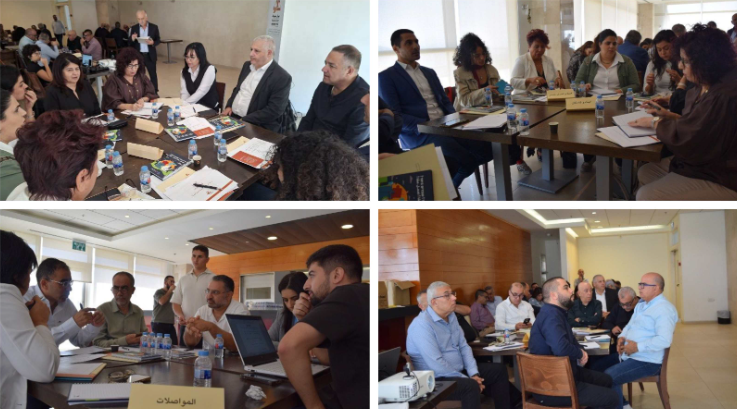
In light of this dire situation, on Friday, 21.11.2025, the Mossawa Center launched an initiative at the Nazareth Industrial Park, in cooperation with the Equality Promotion Division of the Histadrut (The New General Workers Federation), aimed at securing Nazareth’s rightful share of governmental development budgets. The event was attended by dozens of elected municipal council members, along with experts and activists from the city. During the meeting, specialized working groups were formed to follow up on issues related to education, industry and employment, social welfare, transportation, environment, health, culture and sports, tourism, construction and housing, and infrastructure. These groups will prepare professional proposals outlining Nazareth’s needs, to be presented before the appointed professional committee and relevant government ministries, with the aim of formulating an integrated development plan based on accurate data and a shared vision.
The Executive Director of the Mossawa Center, Suha Salman Mousa, opened the meeting by emphasizing the importance of community organizing in securing economic and social rights, referencing the Center’s accompaniment of Jisr az-Zarqa in obtaining a government decision. She noted Minister May Golan’s attempts to take control of development budgets and divert them to the police instead of to developing Arab towns. Salman Mousa affirmed that the crisis facing Nazareth is not fate but the result of policies that can be changed through professional work and broad partnerships. She stressed that this initiative is not a one-time event but a strategic step aimed at developing a vision that obligates government ministries to assume their responsibilities.
Aziz Basyouni, Head of the Equality Promotion Division in the Histadrut, highlighted the importance of addressing employment and industrial issues, which are among the most pressing concerns for the people of Nazareth due to high unemployment rates, particularly among young people and women. This, he said, requires building a comprehensive economic plan that expands job opportunities, supports local industries, attracts large industries, and strengthens professional initiatives that create genuine and sustainable employment pathways.
Participating via Zoom, the Director General of the Nazareth Municipality, Nahida Mansour, reaffirmed her commitment to a wide consultative process with city residents aimed at developing Nazareth and helping it emerge from its current crisis. She explained that the municipality’s budget deficit stands at approximately 349 million shekels, noting that the municipality will approach all government offices to obtain development budgets and balancing grants, and to secure the resources necessary to advance the city and enhance services for its residents.
Mossawa Center Director Jaafar Farah presented key data collected by the Center regarding development budgets allocated to Nazareth, which are supposed to be utilized to improve infrastructure and essential services in the city. He explained that Nazareth needs around 191 new classrooms to address overcrowding, and that the Ministry of Housing has not issued any housing marketing tenders since 2023, exacerbating the housing crisis. He also pointed out that several funding requests in Ministry of Housing tenders were rejected due to the lack of local matching funds required to complete the projects. Farah stressed the importance of combining professional work with popular action to influence the appointed committee’s work and ensure that Nazareth’s rights are fully secured.
Engineer Sharif Zuabi, an elected Nazareth municipal council member representing the Democratic Front for peace and equality (al-Jabha), spoke about the importance of restoring the city’s vitality after one of the most difficult periods it has experienced in recent years. He announced an initiative to form a “Shadow Municipality,” which would serve as a professional and community-based framework working alongside the municipality and civil society organizations to pressure government ministries and institutions for Nazareth’s rights and to ensure serious follow-up on the city’s needs and development.
Iman Saleh, an elected municipal council member representing the United Arab List, spoke about the importance of rebuilding trust among the city’s various political and social components, emphasizing that overcoming past mistakes is an essential step toward preserving and developing Nazareth. She highlighted the need for joint work and collective responsibility to ensure a better future for the city and its residents.
Activist Hani Najm emphasized the importance of establishing active popular committees in Nazareth and strengthening coordination between them, political parties, and elected representatives, as such cooperation is a key component in building an organized community force capable of exerting pressure, maintaining follow-up, and formulating a shared vision to secure the city’s rights and enhance its presence in decision-making centers.
Nazareth Front Secretary Maher Aabed confirmed the Front’s readiness to cooperate with all serious initiatives that serve the city’s interests and contribute to resolving its current crisis. He emphasized that the Front will begin holding meetings with various local groups and initiatives and will communicate with active institutions in the city in order to support and build joint work plans that strengthen development efforts and help Nazareth regain its role and status.
The specialized working groups discussed the current situation in Nazareth across various fields. Each group presented initial proposals, which were reviewed by their representatives as a first step toward building a comprehensive work plan for the city:
Health:
Dr. Nour Abdelhadi Shahbari presented a comprehensive overview of the major health challenges facing Nazareth and proposed holding an expanded meeting with all the city’s health institutions to develop a strategic plan to close existing health gaps. She noted that in recent years, Nazareth lost approximately 3.5 million shekels that were supposed to be allocated for establishing a municipal health unit, in addition to around 5 million shekels allocated for walking trails aimed at promoting healthy lifestyles and encouraging popular sports. She also noted that Nazareth ranks first among Arab towns in rates of diabetes, which requires a comprehensive professional intervention to improve overall public health.
Education:
Teachers Rafee Shihbari and Raji Mansour presented a focused overview of the challenges and opportunities within Nazareth’s education system, emphasizing the need to continue building classrooms and to develop educational content that meets students’ needs and modern developments. They stressed the importance of addressing school dropout rates among youth by creating supportive educational frameworks that respond to students’ needs and accompany them academically and psychologically. They also noted the necessity of establishing a framework to support parents by providing them with information and guidance to enhance their role in the educational process. The group concluded that Nazareth needs a 20-year strategic plan for its education system that ensures infrastructure development, improved educational quality, and readiness for the city’s future. Dr. Hadeel Kayal, Head of the Follow-up Committee for Arab Education, participated in the discussion and expressed the committee’s readiness to support Nazareth’s demands.
Transportation:
Engineer Albair Andrea presented the main challenges discussed by the engineering group in the field of transportation, highlighting the importance of developing the high-speed railway line between Haifa and Nazareth in a way that serves the city’s neighborhoods directly and efficiently. He also stressed the need to establish a modern central bus station that connects incoming routes from outside the city with local routes serving the neighborhoods, thereby improving mobility, reducing congestion, and enhancing service quality for residents.
Construction and Housing:
Engineer Hiba Buwardi presented a summary of the engineering group’s work, emphasizing the importance of expanding Nazareth’s municipal boundaries and developing detailed zoning plans for the city and its neighborhoods to meet residents’ real needs. She stressed the need to advance urban renewal projects, particularly in the old industrial area, and to encourage the restoration and renovation of historic buildings in the Old Market and older neighborhoods to enhance the city’s urban and tourism character.
The group agreed on the importance of investing in developing human capacities within the city’s engineering, planning, and building departments, as well as ensuring the participation of Nazareth’s appointed committee in district planning meetings to guarantee the city’s interests in planning decisions. Economist Marwa Zuabi also presented a new program aimed at supporting young couples and families in obtaining housing loans and providing professional consultations to help them enter the housing market and improve their chances of economic and social stability.
Industry and Employment:
Economist Amin Fares presented a summary of the industry and employment group’s work, stressing the importance of completing detailed plans for the industrial zone shared between Nazareth and Reineh, and marketing the new industrial area as a space capable of attracting high-tech companies and advanced industries. He suggested demanding a redistribution of revenue from industrial zones built on Nazareth’s lands but annexed to the jurisdiction of Nof HaGalil, similar to cases in other areas. The group also emphasized the importance of attracting new employers to the city and developing training and vocational programs to integrate workers—especially youth and women—into the labor market effectively and sustainably.
Social Welfare:
Riham Abu Al-Asal, head of Na’amat in Nazareth, presented a summary of the discussions within the social welfare group, which emphasized the need to develop infrastructure for social services and strengthen community work in neighborhoods. The group highlighted the importance of establishing professional centers to support low-income families in a systematic and sustainable manner. They stressed the urgent need to appoint a director for the social welfare department as soon as possible to ensure professional leadership capable of advancing the department. The group also called for a long-term plan to address social challenges in the city, in coordination with the appointed committee, NGOs, and government institutions—particularly the National Insurance Institute—to build an integrated support network serving all population groups.
Culture and Sports:
Municipal council member Maysara Abu Shahada presented a summary of the culture and sports group’s discussions, emphasizing the importance of developing infrastructure for cultural production in Nazareth, including theater, folk dance, visual arts, music, singing, and cinema, in addition to supporting active cultural associations in the city. The group stressed the need to provide diverse sports frameworks and to organize tournaments and competitions between neighborhoods to promote sportsmanship and build bridges among residents. They proposed reviving the annual city marathon previously organized by the municipality for many years. The group also highlighted the importance of constructing six sports halls funded by Toto (Lottery) -Winner to host sports activities in neighborhoods and provide safe, equipped space for youth and children.
Tourism:
Tariq Shahada presented a summary of proposals from the tourism working group, which stressed the need to develop infrastructure capable of accommodating incoming tourism efficiently and respectfully. The group highlighted the importance of increasing the number of hotel rooms in the city, establishing a municipal tourist information center to provide visitors with information and appropriate services, and leading professional marketing campaigns to strengthen Nazareth’s status as a central tourism destination. The group also emphasized the vital role of the Old City and Nazareth’s historic market, stressing the importance of preserving their unique cultural, architectural, and religious heritage and encouraging tourists to visit them as the historical and cultural heart of the city.
The working groups began summarizing their short-term proposals for the years 2025–2026, and will begin in 2026 drafting strategic work plan proposals for the years 2027–2031, with the aim of building a comprehensive and sustained vision for the development of the city across all sectors.
