


The Network of Arab Aspiring Women, “Shabaket Reyadiyat”, led by the Mossawa Center, concluded its first year after a journey throughout 2025 that focused on strengthening the effective presence of Arab women in decision-making positions at the local, regional, and national levels.
Implemented within a national participatory framework alongside civil society organizations of We Power, Nivcharot, and Itach Maaki, with funding from the European Union and the Friedrich Ebert Foundation, the project went beyond a training-oriented approach in its first year and moved toward building an active feminist network. This network produced field initiatives led by participants from their respective positions.
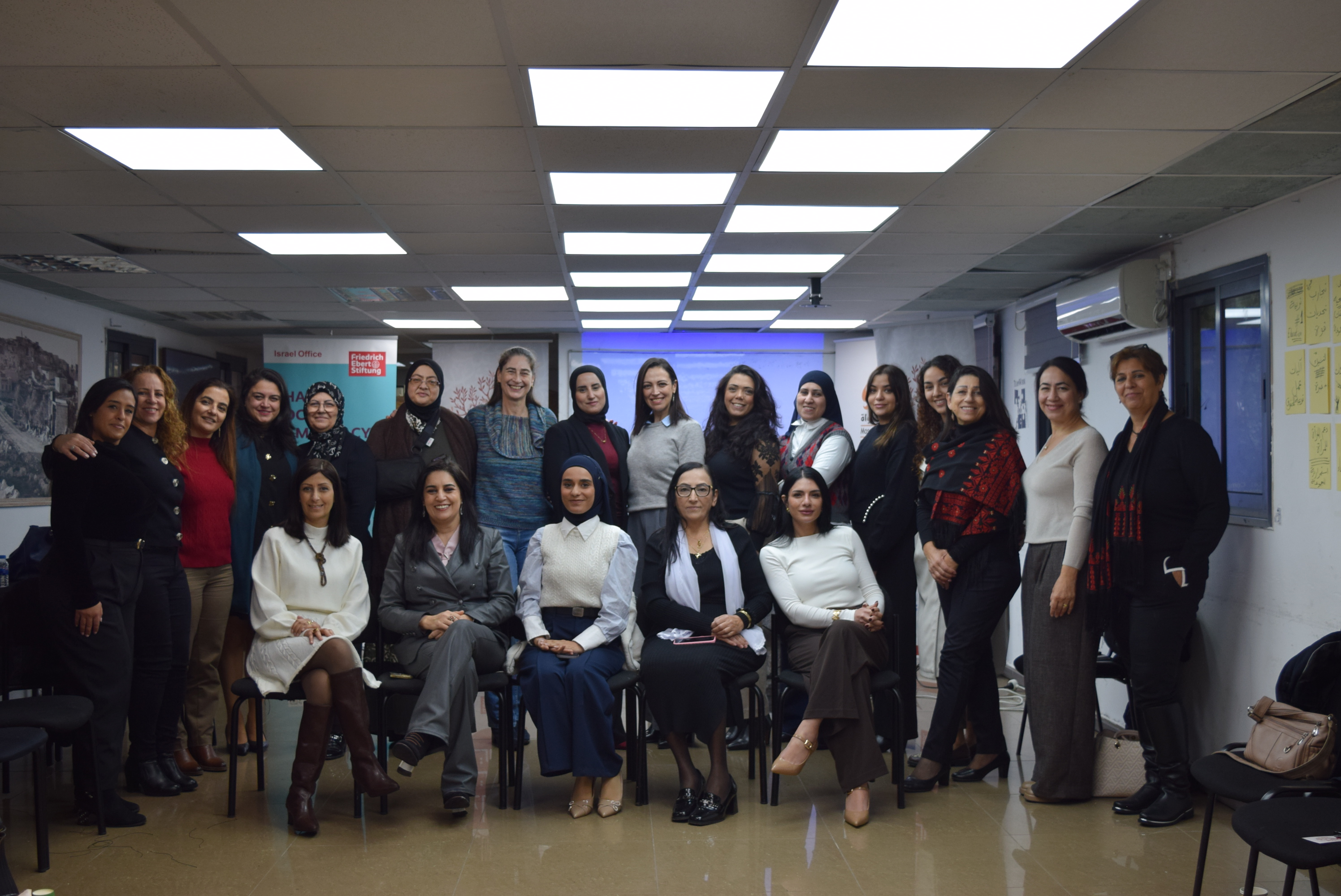
The closing meeting of the first year, held last Friday, 12thDecember, 2025served as an evaluation milestone for the project’s initial phase. It reviewed the activities and events carried out during the year, alongside local feminist initiatives that reflected the participants’ transition from individual empowerment to organized collective action.
Dr. Rawda Morkus Makhoul, project coordinator at the Mossawa Center, stated that the central goal of the initiative is to bring about structural change in decision-making patterns. She emphasized that the project focuses on building a sustainable feminist network capable of influencing public policy, rather than merely promoting symbolic representation of women. She added that the results of the first year lay the foundation for an expansion phase based on accumulated experience, trust-building, and strengthened collective work among participants.
Suha Salman Mousa, Executive Director of the Mossawa Center, stressed that the end of the Network of Arab Aspiring Women, is a first step station in a long-term journey. She noted that what distinguished the network’s work during the year was commitment, continuous communication, and collective thinking among participants. She added that the slogan accompanying the network, “We, not I”, practically expressed a model of collective leadership that places joint action at the center of change, and she called on pioneering women to continue developing the network and launching new initiatives in the coming phase.
During the meeting, Mossawa Center Director Jafar Farah highlighted socio-economic discrimination against the Arab community, with particular focus on how the latest government decision of cutting down in the 55o budget plan would affect women and youth. He pointed out that state budget cuts exacerbate existing gaps and that the absence of women from decision-making centers limits the ability to confront such policies.
Ms. Judith Stielmach, representative of the Friedrich Ebert Foundation, who conveyed the foundation’s greetings and support for the continuation of the project, recognizing the practical framework it provides for strengthening Arab feminist leadership.
Four local thematic initiatives planned and implemented by Reyadiyat network members, Bayan Hujeirat (Halisa, Haifa) , Rasha Ismail (Majd el Kurum), Muna Massarwi (Taybeh) and Hanadi Baya’a (Akko) were showcased, receiving enthusiastic appreciation.
As part of the project Dr. Morkus-Makhoul announced that recruitment and selection of the second cohort of aspiring women will take place within the next two months.
The project to intensify the presence of women in decision-making positions is a long-term national initiative aimed at creating feminist leadership networks capable of systematically influencing the political, social, and economic reality of the Arab community.
