


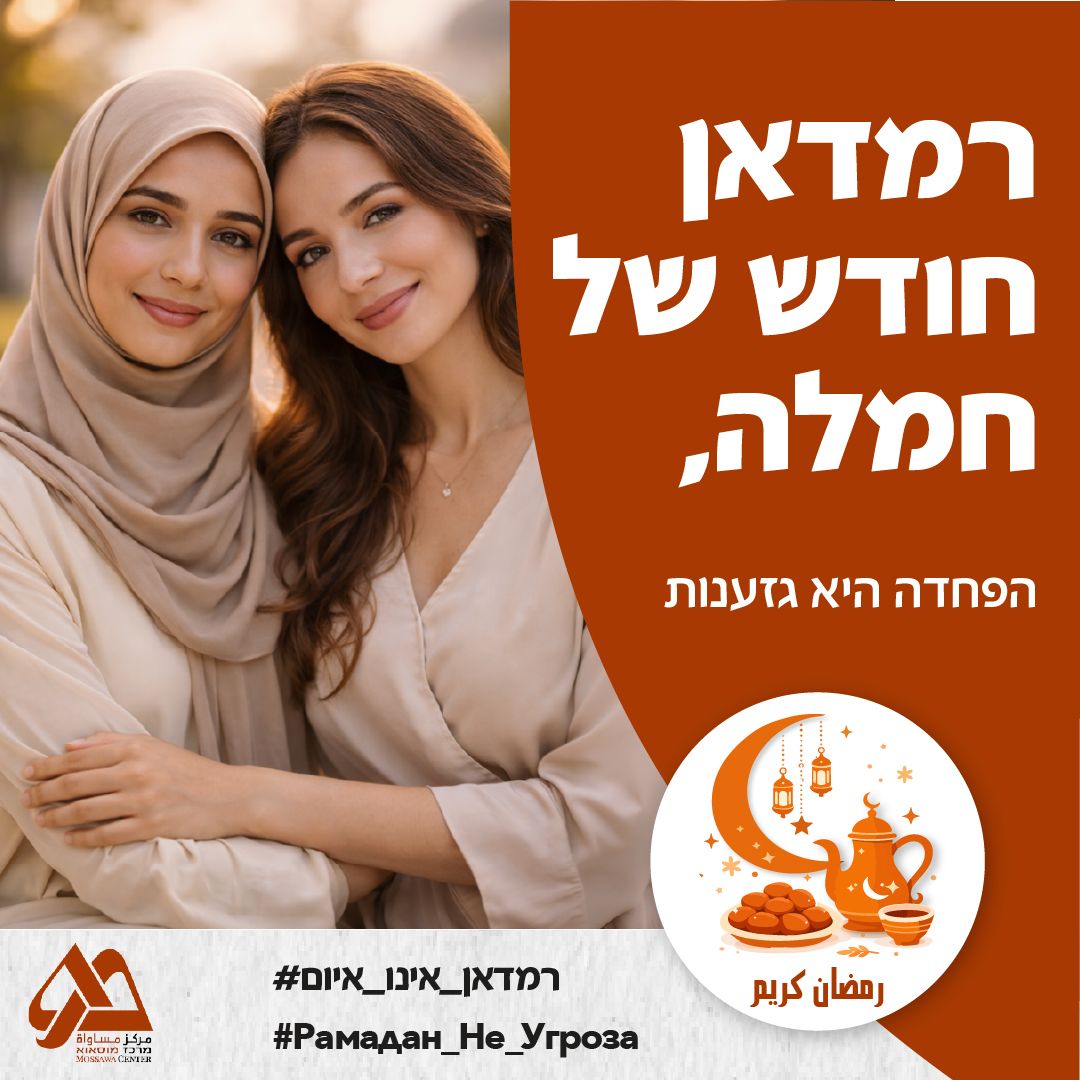
Again the mantra returns about “security preparedness ahead of Ramadan.” Again articles are published in which police and army officers warn of possible scenarios during the fasting days. Once again the holy month is portrayed as an “explosive event” that requires special security alertness. Imagine, for a moment, similar warnings being published ahead of Jewish holiday such at “Yom Kippur” in New York. There is no doubt that this would be perceived as blatant incitement. The Mossawa Center is launching a public awareness campaign aimed at confronting racist incitement against Ramadan.
Ramadan is the longest and most challenging fast for nearly one billion Muslims around the world. It is a central month for Muslim neighbors, not only between the sea and the river. Living in a region where Jews have chosen to live requires understanding the most important month of the year for the Arab and Muslim region. Despite this, the Israeli political and security establishment repeatedly insists on framing it as a tense and dangerous month. Instead of seeing it as an opportunity to strengthen trust and good neighborly relations, it is painted in the colors of threat.
There are those who make a living from presenting themselves as experts on Arab and Islamic society and continue to fuel suspicion. Advisors within the security system feed the media with early messages about a “potential escalation.” IDF Chief of Staff Eyal Zamir issued a warning that the month could be accompanied by security escalation and clarified that any destabilization in the West Bank would require redeploying forces from other sectors and calling up reservists. In reality, the broader regional tensions, including the war against Iran, are what affect the situation—not the mere existence of the month of Ramadan.
Police Commissioner Danny Levy, together with the Ministry of Interior, held a preparatory meeting with imams and Muslim public figures from Arab society. At the same time, police officers were sent to issue fines for exceeding the permitted loudspeaker volume in mosques in Tel Sheva, Lakiya, and Lod. Many perceive these steps as selective law enforcement. The Minister of National Security Itamar Ben Gvir promoted regulations allowing police volunteers to issue environmental fines without a clear definition of the offenses, creating a real opening for selective enforcement against mosques and religious institutions.
To understand the meaning of Ramadan, one must look at the daily routine of those who fast. The beginning of the month is determined by the sighting of the moon. This year the Mufti of Jerusalem declared the start of the fast on Wednesday, in coordination with the Mufti of Saudi Arabia, while other countries in the Arab and Muslim world marked the first day on Thursday. The difference itself illustrates the religious and communal nature of the process, which relies not on a political mechanism but on a long-standing religious tradition.
The fast lasts from dawn until sunset. The times of “imsak” امساك(the moment to stop eating before dawn) and “iftar” إفطار(the breaking of the fast) resemble in many ways the times of Yom Kippur and the beginning and end of the Shabbath (Saturday) in Jewish tradition. Before dawn, those fasting wake up for the suhoor سحور meal, intended to help them endure an entire day without food or drink. It is a significant physical and mental effort that requires self-restraint and personal discipline.
In Israel, work and study routines are hardly adapted to the Muslim fasting hours. Workers go to their jobs as usual, and pupils and students attend schools and universities after a particularly short night. Some workplaces show consideration and allow early departure so people can reach the iftar meal on time, but there is no broad policy regulating this.
After iftar, Tarawih prayers صلاة التراويحtake place in mosques. Children and young people who do not attend prayers often wander the streets due to the lack of cultural and recreational frameworks. Those who visit Arab countries discover that rich cultural life takes place precisely during the nights of Ramadan, after the prayers. Many Arab citizens who travel to Ramallah or Amman experience the unique atmosphere of the month. In Israel, however, in most Arab towns families gather at home and the public sphere remains poor in activity.
Prayers at Al-Aqsa Mosque, the second holiest site in Islam, are considered a central event every day of the month. On Thursday nights buses depart—many donated in memory of deceased relatives—to transport worshippers to the site. In recent years steps have been taken against organizations that assisted worshippers traveling to Jerusalem, and activists have been banned from Al-Aqsa Mosque for extended periods. This year there is no coordination with the Waqf regarding procedures within the compound, including the issue of bringing food for iftar meals.
In addition, changes to the status quo at Al-Aqsa introduced in the past two years continue, including permits for prayer and study circles in the eastern part of the compound. This is despite previous commitments given to Jordan, which assumed responsibility for safeguarding the mosques in Jerusalem. At the same time, Israel decided to allow entry for only 10,000 Palestinians from the West Bank on Fridays during the month, subject to age restrictions, while extending the duration of Jewish visits in the morning hours. Since the beginning of the war against Iran Al Aqsa is closed.
Within Arab society, fears are growing about a scenario of internal escalation. The violent events of May 2021 in mixed cities left a deep scar. In various communities barriers and concrete blocks were placed, including in Lod, Tarabin, Jisr az-Zarqa, and Fureidis. Incidents in which civilians were killed during clashes with police have strengthened the feeling of distrust and fear of further deterioration.
Ramadan is the month of self-restraint, reflection, and giving. Muslims are commanded to give charity and support the poor. It is customary to invite neighbors, friends, and relatives to shared meals that strengthen the social fabric.
One of the spiritual peaks of the month is the 27th night, Laylat al-Qadr (“ ليلة القدر”), the night on which the Qur’an is believed to have first been revealed. In the Qur’an it is described as: “Peace it is until the rise of dawn.” This verse embodies the essence of the month. Historically Ramadan was shaped as a month of prayer to God, spiritual deepening, and improving social relations—not a month of wars. Although battles occurred during different historical periods in Ramadan, they did not stem from its religious essence. The fast itself, which involves reduced physical activity, contradicts the claim that it is a month of war or jihad.
The attempt to turn Ramadan into a security event deepens the delegitimization of the religion of many citizens of the state. Protecting freedom of religion and worship is a cornerstone of any democratic society aspiring to multiculturalism and mutual respect.
The Mossawa Center is launching a public awareness campaign aimed at confronting racist incitement against Ramadan. The center calls for respecting the right of Muslims to pray, fast, and conduct their lives according to their faith, and invites the Jewish public as well to join the demand to stop incitement during the month and until the Eid al-Fitr holiday. The intimidation campaign taking place this year is a racist campaign against more than one billion people, many of whom live in mixed cities.
The Mossawa Center operates through public donations. Support for its activities makes it possible to continue the struggle for equality, freedom of religion, and a shared society that respects all its citizens.
