


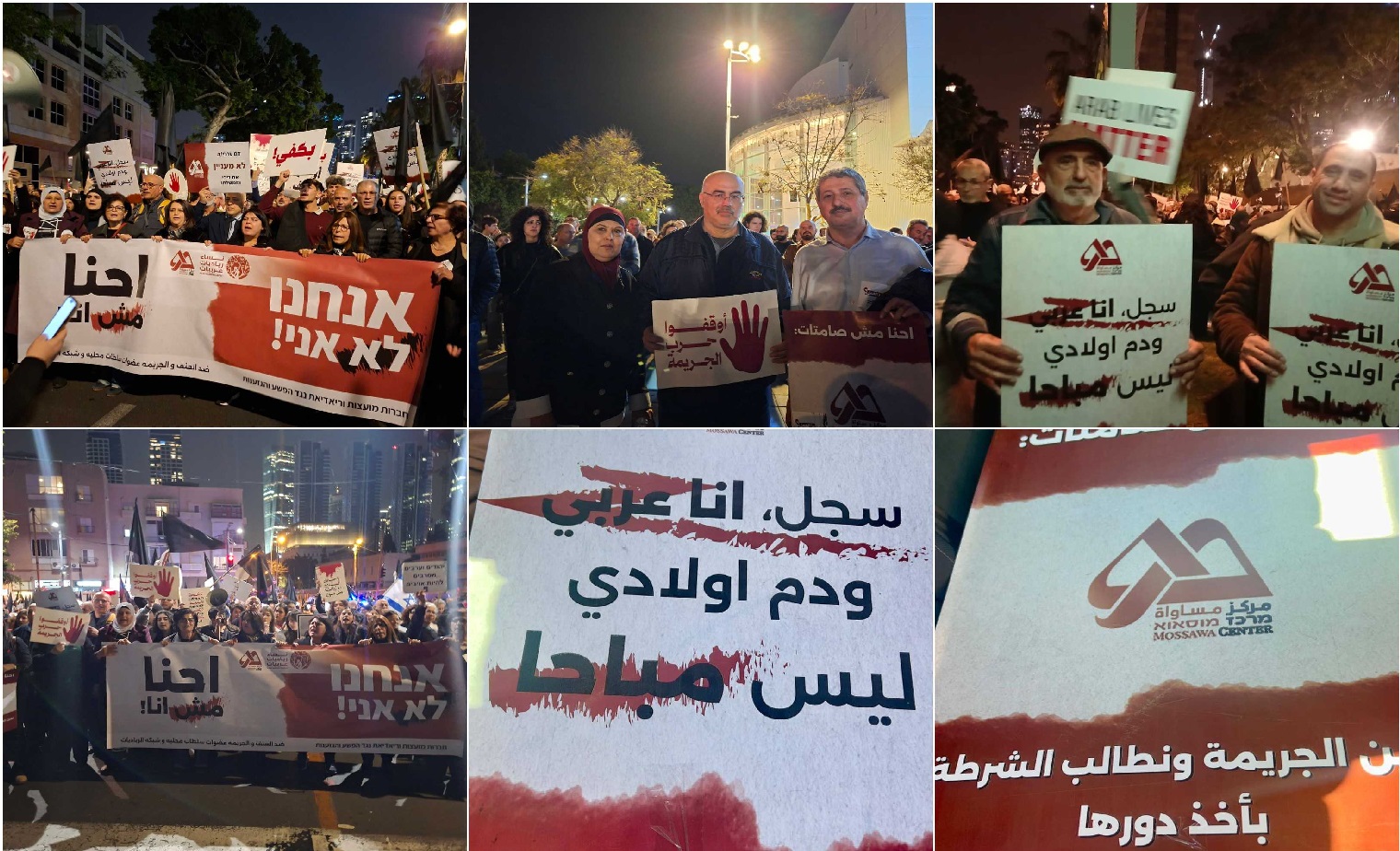
On 31 January 2025, approximately 70,000 people participated in a large public demonstration in Tel Aviv, organized by the High Follow-Up Committee for Arab Citizens of Israel. The protest addressed the ongoing escalation of violence and organized crime in Arab communities inside Israel, as well as what organizers and participants described as persistent government failure to provide effective protection and law enforcement.
The demonstration was held without party symbols or partisan affiliation. Many participants wore black clothing as a sign of mourning for victims of violent crime. At the front of the march were bereaved families holding photographs of relatives who were killed in shootings and other violent incidents. Participants called for structural changes in state policy toward crime prevention, accountability for police failures, and effective action against criminal organizations involved in illegal weapons trafficking and extortion. The demonstration also included calls for the removal of the Minister of National Security, citing responsibility for the ongoing crisis. The closing segment of the event was moderated by journalist Shireen Younes.
Speakers at the rally included representatives of local authorities, civil society, academia, cultural figures, and family members of victims. Dr. Jamal Zahalka, Chair of the High Follow-Up Committee, stated that the protest reflected broad societal concern and collective demand for the protection of fundamental rights, particularly the right to life and personal security. He emphasized that the protest constituted a legitimate, non-violent civic action aimed at ensuring equal protection under the law. Zahalka criticized what he described as discriminatory policing practices and the absence of effective state intervention against organized crime in Arab communities.
Mazen Ghanayem, Chair of the National Committee of Arab Local Authorities and Mayor of Sakhnin, stressed that violence and crime constitute a societal issue affecting the entire population, not only Arab citizens. He rejected claims attributing crime to cultural factors and stated that the core demand is equal personal security for all residents, without distinction.
Talal Al-Qrenawi, Mayor of Rahat, addressed the situation in Bedouin communities in the Negev, referring to patterns of neglect, collective punitive measures, and public incitement. He emphasized that Bedouin citizens are active contributors to society across a wide range of professions and called for non-discriminatory policies, equal citizenship, and meaningful state engagement.
Dr. Thaer Qazal, Head of the Maghar Local Council, warned that the lack of adequate governmental support leaves local authorities with insufficient capacity to address organized crime and protect residents.
Professor Barak Medina of the Hebrew University addressed the constitutional and legal implications of the situation, stating that the state’s failure to ensure the safety of its citizens undermines the social contract and violates the fundamental right to life and personal security, as protected under both domestic constitutional principles and international human rights standards.
Artist and public figure Rivka Michaeli stated that her participation was motivated by concern over what she described as institutional disregard for lethal violence, warning that the normalization of such neglect threatens the ethical foundations of shared civic life.
A central testimony was delivered by Khatam Abu Fana, mother of Firas Abu Fana, who was killed at his workplace. She described the ongoing psychological, social, and economic impact of the killing on her family, highlighting the human consequences of systemic failure to prevent violence and ensure accountability.
The demonstration included significant participation by Jewish activists and democratic organizations, reflecting cross-community solidarity around demands for equality before the law and effective state protection. The daily newspaper Haaretz described the protest as a demonstration against the breakdown of the rule of law.
The Mossawa Center participated in the mobilization and organizational efforts under the framework of the High Follow-Up Committee. In coordination with civil society organizations, local authorities, political representatives, and grassroots initiatives, the Center assisted in logistical arrangements, including transportation, and disseminated informational materials in Arabic, Hebrew, English, and Russian to media outlets and diplomatic missions. The Center also designed and distributed protest materials used during the demonstration. Organized participation by networks of women municipal representatives and community leaders was noted, indicating the broad societal scope of the mobilization.
