


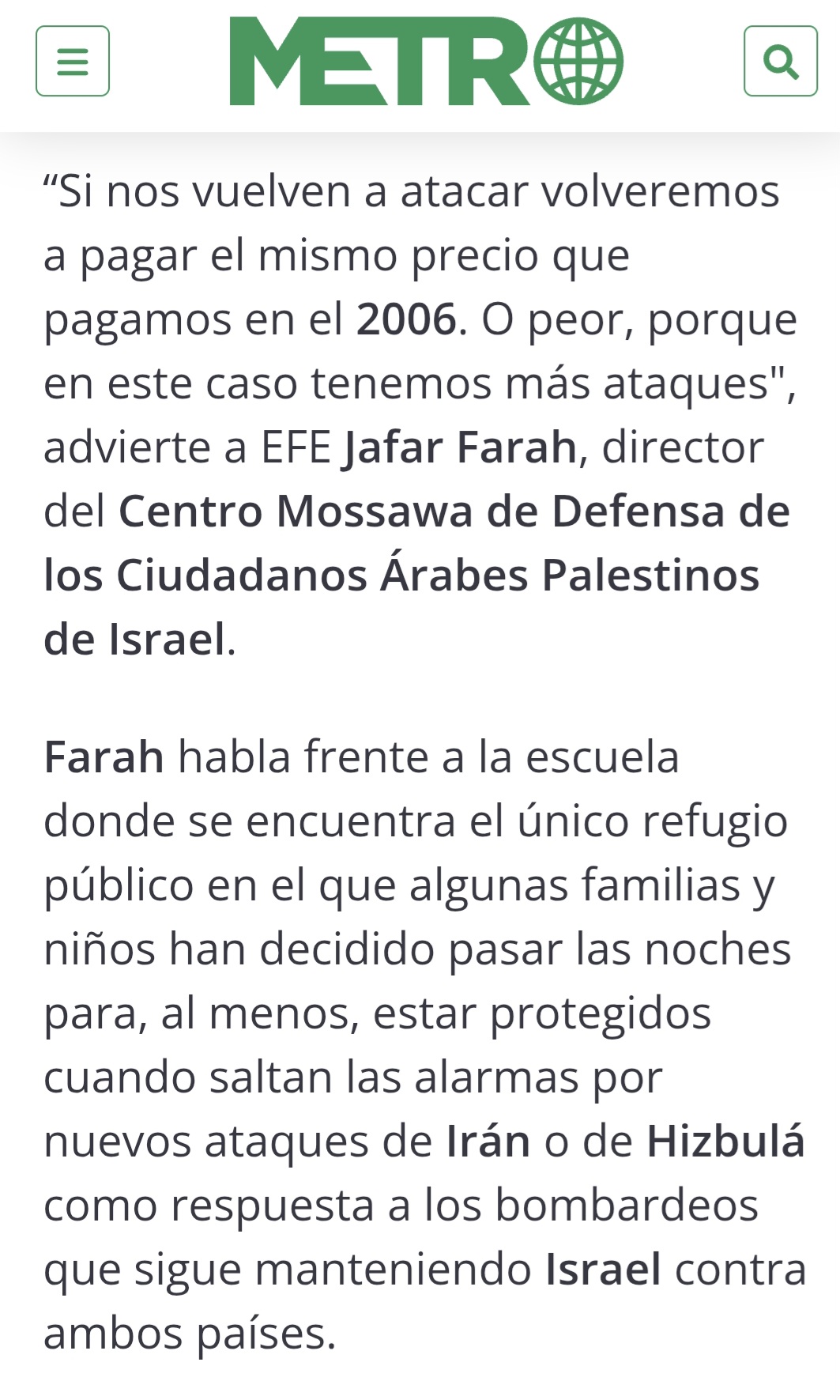
During this week, the Mossawa Center presented the government's policy of discrimination toward Arab society, particularly in mixed cities during wartime, to a group of international media outlets. Jafar Farah, Director of the Mossawa Center, organized a tour for several global news agencies in the Wadi Nisnas neighborhood, the largest Arab neighborhood in Haifa.
Press agencies from Italy and Spain, along with various Arab media outlets, conducted a field visit to shelters in the neighborhood. They documented the small mobile shelter placed on Al-Khoury Street, which can accommodate no more than ten people. The media outlets also visited the municipal shelter at the Al-Ukhuwwa school and community center to observe the conditions of the residents. During the night, shrapnel fell inside a commercial building in the neighborhood, adjacent to the municipal shelter.
Farah pointed out that there are spaces in church schools and civil institutions that could be equipped with shelters to protect residents, but Israeli authorities refuse to build shelters in these areas. The neighborhood paid a heavy price during the 2006 war, when three citizens were killed and dozens were injured following rocket fire from Lebanon.
Farah emphasized that since 2006, the Mossawa Center has been monitoring the issue of discrimination in civilian protection within Arab society by Israeli governments and municipalities in mixed cities. Arab neighborhoods in Haifa suffer from discriminatory planning and licensing policies, as most homes in historic neighborhoods are considered protected heritage sites requiring much more complex licensing processes than standard buildings. Farah stressed the responsibility of the government, which declares war on other countries, to provide equal protection to all its residents.
Several international media outlets have published news and reports on the treatment of the Arab community during the war, citing the Mossawa Center’s position in their coverage.During this week, the Mossawa Center presented the government's policy of discrimination toward Arab society, particularly in mixed cities during wartime, to a group of international media outlets. Jafar Farah, Director of the Mossawa Center, organized a tour for several global news agencies in the Wadi Nisnas neighborhood, the largest Arab neighborhood in Haifa.
Press agencies from Italy and Spain, along with various Arab media outlets, conducted a field visit to shelters in the neighborhood. They documented the small mobile shelter placed on Al-Khoury Street, which can accommodate no more than ten people. The media outlets also visited the municipal shelter at the Al-Ukhuwwa school and community center to observe the conditions of the residents. During the night, shrapnel fell inside a commercial building in the neighborhood, adjacent to the municipal shelter.
Farah pointed out that there are spaces in church schools and civil institutions that could be equipped with shelters to protect residents, but Israeli authorities refuse to build shelters in these areas. The neighborhood paid a heavy price during the 2006 war, when three citizens were killed and dozens were injured following rocket fire from Lebanon.
Farah emphasized that since 2006, the Mossawa Center has been monitoring the issue of discrimination in civilian protection within Arab society by Israeli governments and municipalities in mixed cities. Arab neighborhoods in Haifa suffer from discriminatory planning and licensing policies, as most homes in historic neighborhoods are considered protected heritage sites requiring much more complex licensing processes than standard buildings. Farah stressed the responsibility of the government, which declares war on other countries, to provide equal protection to all its residents.
Several international media outlets have published news and reports on the treatment of the Arab community during the war, citing the Mossawa Center’s position in their coverage.
During this week, the Mossawa Center presented the government's policy of discrimination toward Arab society, particularly in mixed cities during wartime, to a group of international media outlets. Jafar Farah, Director of the Mossawa Center, organized a tour for several global news agencies in the Wadi Nisnas neighborhood, the largest Arab neighborhood in Haifa.
Press agencies from Italy and Spain, along with various Arab media outlets, conducted a field visit to shelters in the neighborhood. They documented the small mobile shelter placed on Al-Khoury Street, which can accommodate no more than ten people. The media outlets also visited the municipal shelter at the Al-Ukhuwwa school and community center to observe the conditions of the residents. During the night, shrapnel fell inside a commercial building in the neighborhood, adjacent to the municipal shelter.
Farah pointed out that there are spaces in church schools and civil institutions that could be equipped with shelters to protect residents, but Israeli authorities refuse to build shelters in these areas. The neighborhood paid a heavy price during the 2006 war, when three citizens were killed and dozens were injured following rocket fire from Lebanon.
Farah emphasized that since 2006, the Mossawa Center has been monitoring the issue of discrimination in civilian protection within Arab society by Israeli governments and municipalities in mixed cities. Arab neighborhoods in Haifa suffer from discriminatory planning and licensing policies, as most homes in historic neighborhoods are considered protected heritage sites requiring much more complex licensing processes than standard buildings. Farah stressed the responsibility of the government, which declares war on other countries, to provide equal protection to all its residents.
Several international media outlets have published news and reports on the treatment of the Arab community during the war, citing the Mossawa Center’s position in their coverage.
