



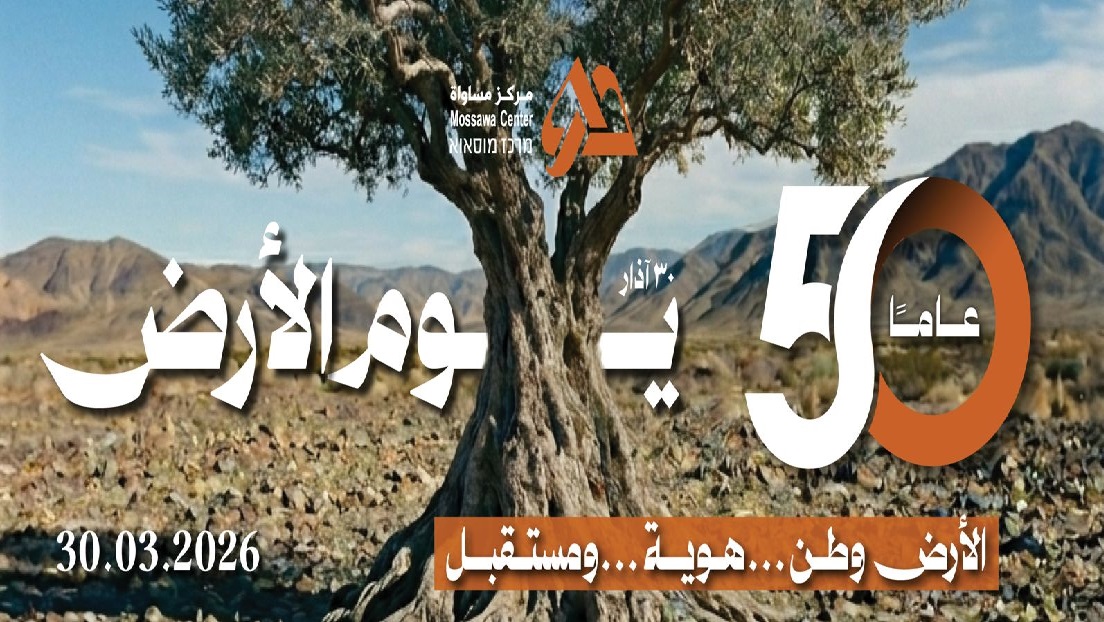
Commemorating 50 years of land day
Jafar Farah – Director of the Mossawa Center
Background – From the Nakba to Land Day
The Palestinian people mark fifty years since the events of “Land Day,” which took place on March 30, 1976. These events, which ended with six people killed by police and military gunfire, dozens injured, and hundreds arrested, marked a turning point in the relationship between Palestinian Arab citizens of Israel and the state authorities.
The displacement that took place in 1948 did not end with the war. The Israeli government prohibited refugees from returning to their homes and lands. Even refugees who left their villages but remained within the state’s borders were expelled from their lands and homes and became internally displaced in their own homeland. One-third of the state’s Arab citizens within the Green Line are internally displaced persons who were expelled from their homes and have not been allowed to return to this day, despite being citizens. Among the villages: Damun, Mjidel, Iqrit, Biraam, Al-Araqib and Tantora.
Immediately after the Nakba in 1948, a military regime was imposed on Arab citizens, restricting their movement within the state. These restrictions included limits on employment, higher education, and access to services. Military rule lasted until 1966 and was lifted thanks to a prolonged struggle by Palestinian Arab society, led at the time by the Communist Party, which succeeded in mobilizing parliamentary support against its continuation.
During the years of military rule, lands were confiscated through various laws. Among them was the Absentees’ Property Law (1950), an Israeli law that allowed the government to transfer the property of Palestinians displaced during the 1948 war (“absentees”) to the Custodian of Absentees’ Property. The law transferred their assets—land, homes, money, and bank accounts—into state ownership and allowed their management or transfer to the “Development Authority”.
An “absentee” was defined as anyone who was a citizen or resident of Israel who, from November 29, 1947 onward, left their place of residence for a place outside Israel or for an area within Israel held by “hostile forces”.
The Custodian of Absentees’ Property, appointed by the Minister of Finance, was granted ownership of these properties and had the authority to manage, lease, or sell them, mainly to the Development Authority. Ownership rights were transferred entirely to the custodian. The law replaced earlier emergency regulations and remains in force today, administered by the Ministry of Finance. Through it, Muslim community properties—including schools, mosques, lands, and cemeteries—were confiscated.
If this law was not sufficient, the government also used the Land Ordinance (Acquisition for Public Purposes) of 1943, allowing land expropriation, alongside the Planning and Building Law. While landowners were entitled to compensation, up to 40% of land could be expropriated without compensation in some cases. The law granted broad powers to the Minister of Finance and government offices.
The Planning and Building Law (1965) also allows local committees to expropriate land under approved master plans. Under Section 190, up to 40% of land can be taken without compensation under certain conditions.
This law also enabled authorities to prevent planning and development in Arab localities, including denying electricity connections to homes built on private land without permits. While the government established enforcement committees, it did not seriously advance planning processes for Arab towns.
The government later amended the law to accelerate home demolitions and established the National Unit for Planning and Building Enforcement. Founded in 1988, its powers were expanded in 2016, and in July 2024 it was transferred to the Ministry of National Security. The unit operates nationwide, identifying building violations, gathering evidence, issuing fines, and carrying out demolitions, often in cooperation with the police.
While strengthening enforcement tools, the government has simultaneously delayed planning approvals, expansion of municipal boundaries, land allocation, and building permits in most Arab communities.
Public Struggle Against Land Confiscation
Public resistance began immediately after land confiscations started in 1948. Lawyers, including such as Advocate Hanna Nakara, filed petitions and appeals, most of which were rejected. Many Arab citizens refused compensation and demanded the return of their lands. Security forces suppressed protests and threatened activists.
The Communist Party led the struggle against military rule and discriminatory laws. Protests were recorded as early as May 1959. Activists faced arrests and administrative orders. The independent movement “Al-Ard” was outlawed and its members imprisoned.
After the 1973 Yom Kippur War, the ruling party, “Mapay”, expanded land confiscation policies, increasing tensions in Arab communities. Leaders openly promoted policies to “Judaize” the Galilee and the Negev, while deepening occupation in territories captured in 1967.
The Communist Party helped establish numerous grassroots organizations, including student unions, human rights groups, and the Committee for the Defense of Land. This committee organized major protests, including a conference in Nazareth in October 1975.
Despite protests, the government expanded Nazareth Illit’s jurisdiction and imposed restrictions on farmers. Efforts were made to pressure Arab local leaders to cancel strikes, but public resistance continued.
Land Day Events (1976)
Land day events began on March 29, 1976, with security forces imposing curfews and making arrests in the Galilee. The first fatality occurred that night in Arabe village.
On March 30, police shot and killed protesters in several locations, including Sakhnin, Kafr Kana, and Taybeh. Dozens were injured and many arrested. Police also raided the home of Knesset member Tawfiq Ziad.
The following day, opposition lawmakers submitted a no-confidence motion, which was defeated be the coalition with the support of the opposition parties.
Despite the violence, farmers returned to their lands and continued cultivating them, effectively challenging government authority.
Political Changes After 1977
The 1977 elections led to political shifts in Israel and changes in land policy. Later, in 1992, Yitzhak Rabin’s government relied on support from Arab parties.
This period saw the passage of Basic Laws, including the Basic Law: Human Dignity and Liberty, which protects property rights and limits state expropriation powers.
The government also recognized in 1995 several previously unrecognized villages in the Galilee and Negev, though implementation was delayed. At the same time, policies of displacement and land disputes continued, especially in the Negev.
Marking Land Day Amid War
This year’s Land Day is marked under exceptional circumstances due to ongoing conflict and restrictions on gatherings. Arab leadership bodies decided to scale back public events and cancel the main march.
Instead, people are encouraged to visit graves and memorial sites and use educational materials to preserve awareness among younger generations.
The situation in Gaza remains severe despite reports of partial ceasefires, with ongoing destruction, shortages, and humanitarian crisis. In the West Bank, settlement expansion and military actions continue to affect daily life.
Within Israel, Arab society faces growing challenges in land, housing, and planning. Demolitions continue in the Negev, while development delays persist in the Galilee and the Triangle, worsening housing shortages.
Crime rates have also risen sharply amid insufficient government response.
The regional war with Iran has had direct effects, including missile strikes near Arab communities, exposing gaps in emergency preparedness and infrastructure.
Economic impacts are also significant, with Arab communities disproportionately affected by poverty and budget cuts.
conclusion
Fifty years after Land Day, struggles over land and fundamental rights continue and are even intensifying. Despite reduced activities this year, Land Day remains a central moment for reaffirming connection to the land, raising awareness, and continuing the fight for equality and justice.
The 50th anniversary highlights that the struggle over land and rights is ongoing and will remain central to public and national discourse.
